Number of courtyards
4 + HaremA plan narrowing from outer to inner
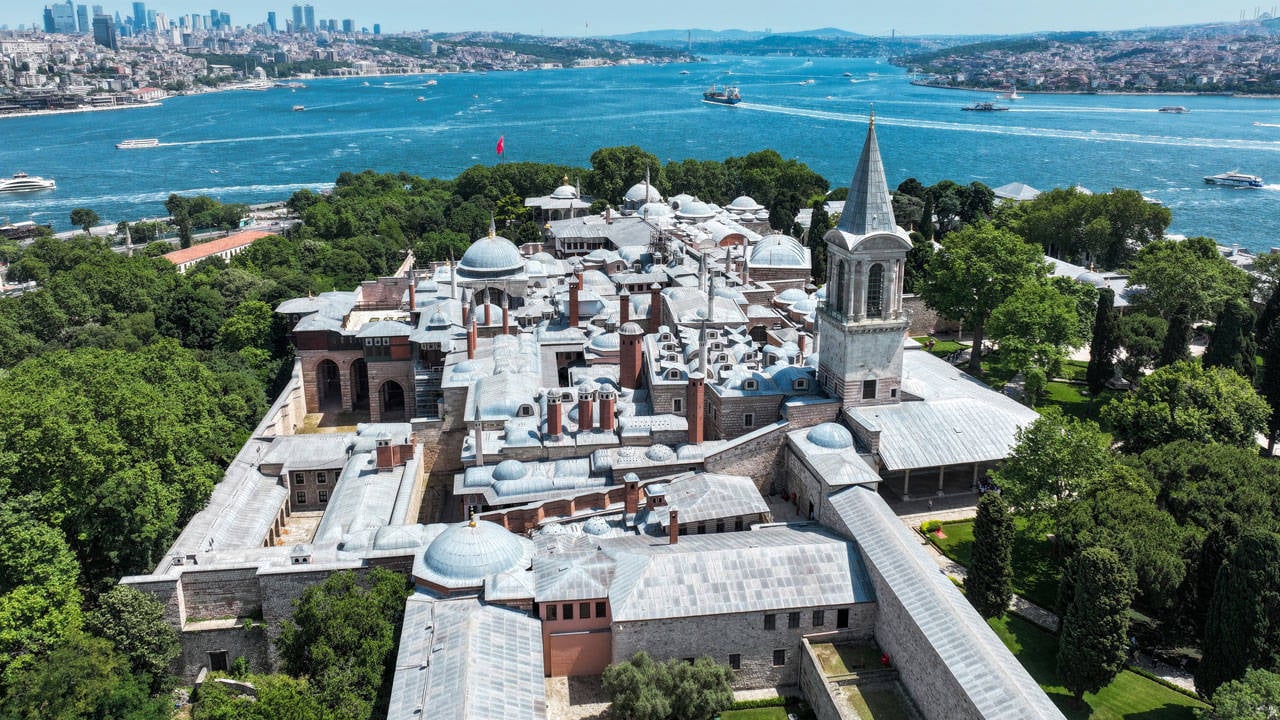
Get to know the palace, made up of four courtyards and the Harem, room by room: from the Imperial Gate to the Baghdad Kiosk with its Bosphorus view, which section is where, how long it takes and how to tour it.
Independent guide — this is not the official website ⓘ
A hand-picked set of experiences related to this page, bookable online.
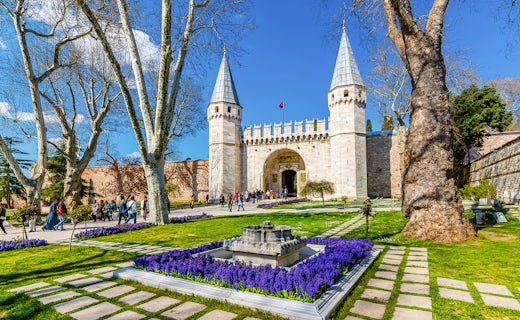
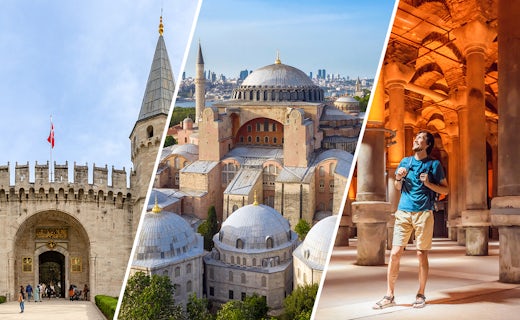

Topkapi Palace is not a single building; it's a walled palace-city of around 700,000 square metres. Its architectural logic is simple but striking: four courtyards narrow from the outer to the inner, and each gate brings you one step closer to the sultan. While anyone could enter the outermost courtyard, only palace officials and invited guests could reach the innermost, fourth courtyard.
Understanding this hierarchy puts everything in its place as you tour the palace. The first courtyard is the public area where the people and the state met; the second courtyard is the ceremonial square where affairs of state were conducted; the third courtyard is the sultan's private world; and the fourth courtyard is a garden of rest and pleasure. The Harem quarters, meanwhile, extend alongside this axis like an intimate labyrinth where the sultan's family lived.
Below we describe each courtyard and the sections within it in order, room by room. At the end you'll also find how long each section takes and the most efficient visit route. If it's your first time, following this order is good for both your feet and your plan.
| Section | Highlights |
|---|---|
| First Courtyard | Imperial Gate, Hagia Irene, old mint, gardens — free area |
| Second Courtyard | Gate of Salutation, Imperial Council, Tower of Justice, palace kitchens, Harem entrance |
| Third Courtyard | Gate of Felicity, Audience Chamber, Library of Ahmed III, Treasury, Sacred Relics |
| Fourth Courtyard | Baghdad Kiosk, Revan Kiosk, İftariye Pavilion, Circumcision Room, tulip gardens |
| Harem | 300+ rooms, Valide Sultan Apartments, Imperial Hall, İznik tiles |
Section contents are based on data from the official millisaraylar.gov.tr website; some rooms may be temporarily closed for restoration.
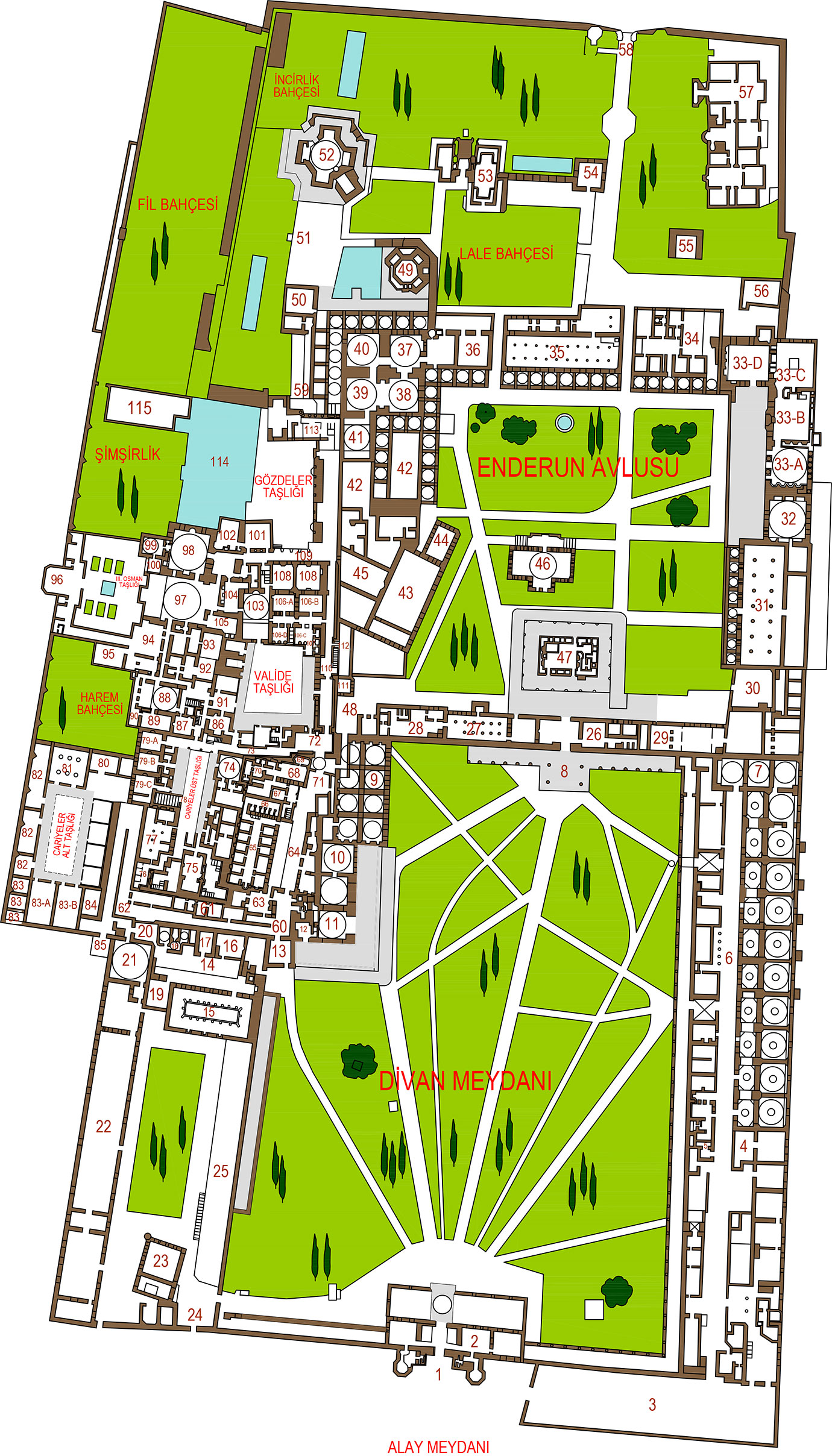
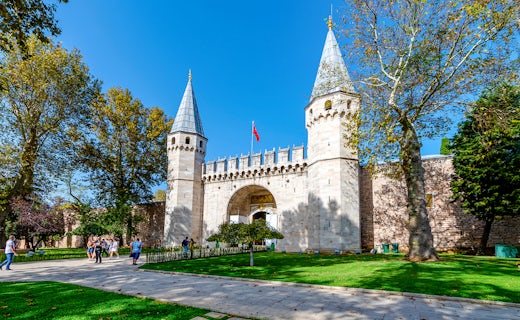
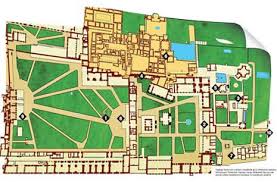
Taking one look at the plan before touring the palace stops you getting lost inside. The main axis runs like a single straight line: Imperial Gate (Bâb-ı Hümâyun) → Gate of Salutation (Middle Gate) → Gate of Felicity (Gate of the White Eunuchs) → Audience Chamber. These three gates draw the boundaries of the three courtyards.
The Harem and the kitchens lie on either side of this axis; the kiosks and gardens are gathered furthest in, in the fourth courtyard. Find this axis on the plan handed out at the entrance or posted at the turnstile; the rest follows on its own. My personal tip: download a sketch of the palace to your phone, because in some corners the direction signs are sparse.
As you read the plan, keep one thing in mind: distances in the palace are longer than they appear on paper. The courtyards are wide, the kiosks set apart from one another, and the Harem a wholly separate block. So factor in the walking time when moving from one section to another. The good news is that, thanks to the main axis, it's possible to build a route that flows forward without doubling back — which both saves time and keeps you from running into the same crowd twice.
The palace's first gate is the Imperial Gate (Bâb-ı Hümâyun); you enter right beside Hagia Sophia. This gate is the palace's face looking out to the public, outside world. Once through, you reach a wide, wooded courtyard, the Parade Ground (Alay Meydanı). This was once the public area where state ceremonies, janissary parades and the people gathered.
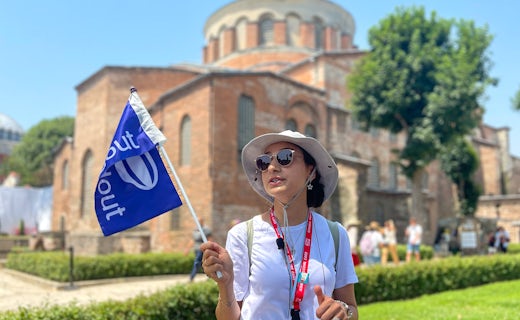
There are two important structures in this courtyard:
The first courtyard is free; the real palace turnstile begins at the second gate. Don't rush here — seeing the plain but vast interior of Hagia Irene is worthwhile in itself. Time: 15–25 minutes.
The Gate of Salutation (Bâbüsselâm / Middle Gate) is the point with the real palace turnstile; it's instantly recognisable by its two pointed towers. In the past everyone except the sultan dismounted here. Through this gate you step into the second courtyard, the heart of the state.
The main sections of the second courtyard:
The second courtyard is the widest and most crowded part of the palace. Don't miss the porcelain display in the kitchens. Time: 30–45 minutes.
An overlooked treasure: the celadon porcelains in the palace kitchens aren't only beautiful; according to legend they were especially favoured at the sultan's table because they were believed to change colour on contact with poison. Don't hurry past the display cases — this collection is one of the largest assemblies of porcelain outside China.
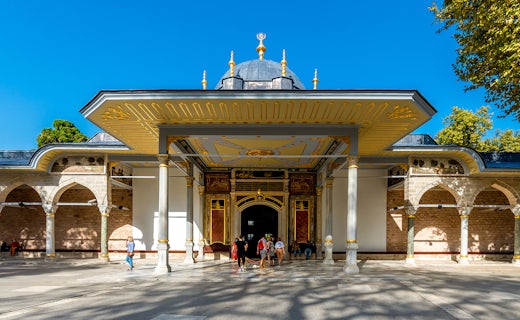
The Gate of Felicity (Bâbüssaâde / Gate of the White Eunuchs) is the gate that opens onto the sultan's private world. Beyond this gate is the Enderun, the inner palace; in the past only chosen people could enter here. Just behind the gate, the Audience Chamber greets the visitor.
The third courtyard is the most sought-after part of the palace. A queue can form in front of the Treasury and the Sacred Relics; if you come early in the morning you'll see the Spoonmaker's Diamond at ease. Time: 45–60 minutes.
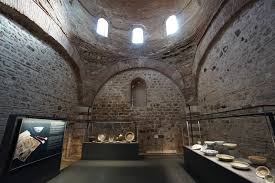
The Imperial Treasury is the reason most visitors come to the palace. The Spoonmaker's Diamond is a giant 86-carat pear-shaped stone surrounded by 49 small brilliants; the story behind its name rests on the legend that it changed hands in exchange for a spoon. The front of the case is crowded all day.
A case away stands the famous Topkapi Dagger: a masterpiece with three large emeralds on its hilt and a hidden watch in its tip. This dagger, also the subject of a 1964 heist film, is the pinnacle of Ottoman jewellery. To get a close look at both pieces, choose the left lane of the queue; it usually flows faster.
The fourth courtyard is the most peaceful and beautiful corner of the palace. This is the place not of affairs of state but of rest and the view. The kiosks rising among the tulip gardens look down from above onto the Golden Horn and the Bosphorus.
The tulip gardens turn into a riot of colour especially in April. This courtyard is the most enjoyable finale of the visit; don't leave without sitting for a few minutes on the marble terrace and watching the Bosphorus. Time: 30–40 minutes.
As you tour Topkapi, look carefully at the walls: İznik tiles in shades of blue, turquoise and coral red appear at every corner of the palace. The Circumcision Room, the Baghdad Kiosk and the Harem corridors hold the most magnificent examples of this tile art.
The 16th century is the golden age of İznik tilework; panels from that period with tulip, carnation and hyacinth motifs are today considered priceless in the world's museums. Seeing these panels in the palace, in their original context, is a privilege in itself. The colours of the tiles look more vivid in the morning light.
We've described the hierarchy of the courtyards; but perhaps the most sought-after section of the palace lies a little outside this axis: the Harem quarters, entered from the second courtyard. The Harem is the private residence, completely closed to the outside, where the sultan and his family lived. With more than 300 rooms and roughly six floors, it counts as a palace in its own right.
Inside, the Valide Sultan Apartments, the domed Imperial Hall, the tile-clad Twin Kiosks and the main corridor known as the "Golden Road" await you. The most magnificent examples of İznik tiles are here. Most visitors say at the end of the visit that "the Harem impressed me most"; because behind these walls lie the palace's real story, its struggles for power and the life of the dynasty.
The Harem is included in the 2,750 ₺ combined ticket but has its own turnstile, and the Müzekart is not valid here. Be sure to look at our Harem page for a detailed account of the section, its standout rooms, who lived there and the calmest time to tour — there we cover the subject in much greater depth.
The key to understanding Topkapi is its gates. Each is not merely a passage but a boundary of status:
As you pass through these three gates, imagine the protocol that once operated at each. As you move from the outside world toward the sultan's presence, you feel that you're entering a world requiring permission and privilege. The palace's whole architectural logic is built on this graduated privacy.
The most efficient route follows the palace's natural axis. To avoid doubling back into the crowds, I recommend this order:
Total: at a relaxed pace, 2.5–3.5 hours. Timing the Treasury and the Harem for the first hours of the morning makes your day much easier. Reading the palace's history in advance makes what you see meaningful; also confirm the current opening hours before your visit.
| Section | Average time | Crowd level |
|---|---|---|
| First Courtyard (Hagia Irene, garden) | 15–25 min | Low |
| Second Courtyard (Council, kitchens) | 30–45 min | Medium |
| Harem | 45–60 min | Medium–high |
| Third Courtyard (Treasury, Relics) | 45–60 min | High |
| Fourth Courtyard (kiosks, view) | 30–40 min | Medium |
The times are averages; for those who love taking photos and reading the story, the total time can stretch up to 4 hours.
Golden-hour tip: the palace opens at 09:00 and is closed on Tuesdays. In the first 45 minutes the Treasury and the Harem are at their calmest; if you tour these two sections as you start the day, you'll walk the kiosks and gardens at ease during the midday crowd. Monday and Wednesday are the busiest days, owing to the Tuesday closure.
The palace is uneven and stone-paved; there are stairs between the kiosks. Comfortable shoes and water with you are a must, because the courtyards are wide and shadeless. In the Sacred Relics section, clothing that covers the shoulders and knees is the right choice for both respect and comfort.
Some sections may undergo restoration in rotation; don't be surprised if a kiosk is closed during your visit. You tour all the courtyards and the Harem on a single combined ticket; you don't need to buy separate tickets. We recommend setting aside half a day to see the whole palace — Topkapi shows its loveliest details not to the one who rushes, but to the one who is patient.
One last reminder: some sections take on meaning not one by one but as a whole. If you see the jewel in the Treasury but skip the story of the Harem, you'll have toured the palace by halves. So divide your time evenly between the courtyards; give each a little breathing room. Reading the palace's history briefly before you start touring helps you understand why every gate and every room you see is there.
The palace consists of four courtyards and a Harem. The First Courtyard (Imperial Gate, Hagia Irene), the Second Courtyard (Imperial Council, kitchens), the Third Courtyard (Treasury, Sacred Relics) and the Fourth Courtyard (kiosks, gardens) are arranged from outer to inner. The Harem is a separate section entered from the second courtyard.
The most sought-after pieces are the 86-carat Spoonmaker's Diamond in the Imperial Treasury and the Topkapi Dagger with three emeralds on its hilt. The Chamber of the Sacred Relics is the most precious section in spiritual terms.
The First Courtyard (the Parade Ground between the Imperial Gate and the Gate of Salutation) is free and requires no ticket. The real palace turnstile begins at the second gate, the Gate of Salutation.
We recommend setting aside 2.5–3.5 hours on average, including all courtyards and the Harem. For those who want to tour the Treasury, the Sacred Relics and the kiosks without rushing, half a day is ideal.
The natural axis is the most efficient route: First Courtyard → Second Courtyard (kitchens, Council) → Harem → Third Courtyard (Treasury, Relics) → Fourth Courtyard (kiosks, view). Touring the Treasury and the Harem early in the morning helps you beat the crowds.
The fourth courtyard holds the Baghdad Kiosk, the Revan Kiosk, the gold-domed İftariye Pavilion, the marble terrace, the Circumcision Room and the tulip gardens. The palace's loveliest view, looking out over the Bosphorus and the Golden Horn, is here.
The Harem is a separate section but included in the 2,750 ₺ combined ticket; you don't need to buy a separate ticket. Its entrance is in the Second Courtyard and it has its own turnstile. For details, see our Harem page.
Book your skip-the-line entry ticket online and save hours of queuing.